Showing posts with label economy. Show all posts

Thursday, October 11, 2012

Incoherence in Economic Policymaking

France has just approved the TSCG, ex-Merkozy, essentially signing on to the austerity bandwagon. At the same time, the IMF has issued its World Economic Outlook, which points out that austerity has already failed and is in fact making matters worse. The incoherence in global economic policymaking could not be more complete. And meanwhile, the US is preparing to fall off the fiscal cliff.

Here is Christine Lagarde's warning:


Christine Lagarde has urged countries to put a brake on austerity measures amid signs that the IMF is becoming increasingly concerned about the impact of government cutbacks on growth. Ms Lagarde, IMF managing director, cautioned against countries front-loading spending cuts and tax increases. “It’s sometimes better to have a bit more time,” she said at the annual meetings of the IMF and the World Bank on Thursday.
The fund warned earlier this week that governments around the world had systematically underestimated the damage done to growth by austerity.
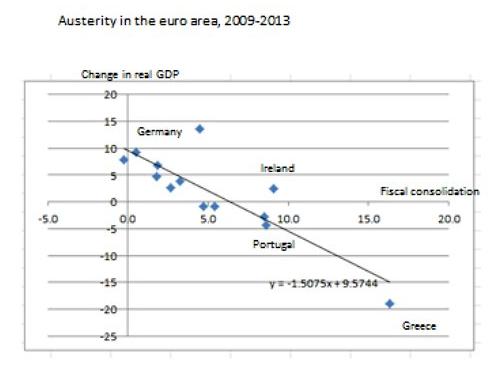
Lagarde gets it, which should give pause to those who blame this crisis on "neoliberalism." If there were such a thing as a neoliberal consensus, the IMF would have to be part of it. But the IMF has gone off in a different direction under the leadership of Lagarde. The WEO contained this graph, which has now been widely reproduced in the blogosphere:

 Paul Krugman explains:

I and others have been arguing for a while that the experience of austerity in the eurozone clearly suggests pretty big Keynesian effects. Here, for example, is what a scatterplot of fiscal consolidation (from the IMF Fiscal Monitor) and growth (including an estimate for next year, from the World Economic Outlook) looks like.
But, you might object, maybe the causation runs the other way; maybe countries in trouble are forced into fiscal consolidation, so it’s not the austerity what did it. But the IMF has an answer to that: it looks at forecast errors versus austerity. Part of the reason for doing this is to figure out why things are going so much worse than expected; but there’s also the fact that the forecasts already included the known problems of the economies in question, so that you’re more or less getting an estimate of the impact of austerity over and above the known problems (and the initially assumed effect of austerity, which was supposed to be small).
Here, "IMF" really means IMF chief economist Olivier Blanchard and economist Daniel Leigh, the authors of "Box 1.1" in the WEO (which can be downloaded here). They argue that the "multiplier" in the world's deleveraging economies is much larger than previously thought, indeed greater than one. Hence fiscal expansion adds more than €1 to GDP for every additional euro of government spending and subtracts more than €1 for every euro slashed by zealous budget cutters. This could make the goal of returning to equilibrium an infinite regress: for every step governments think they are taking toward it, the goal actually recedes by a greater distance. That is why Christine Lagarde is warning of the dangers of a downward spiral into depression. The risk is not negligible, but political systems throughout the developed world seem absolutely incapable of recognizing it. Instead, we slouch toward serfdom.

Tuesday, October 9, 2012

TSCG Adopted

The TSCG has been approved by a vote of 477 to 70, with 282 deputies of the Left voting in favor. In other words, the treaty would not have passed without the support of the Right. Not a brilliant victory for Hollande, but a victory, since he has now committed himself to getting along with Germany. For better or worse, he now owns what used to be called "Merkozy."

Thursday, October 4, 2012

Private Equity Threatens to Leave France

Private equity firms are threatening to leave France because of Hollande's 75% marginal tax on high incomes, which will apparently apply to "carried interest," the private-equity term for gains by fund managers. Some 280 such firms are housed in Paris, and France is the second-largest European market for leveraged buyouts, after Britain, according to the Bloomberg report.

Entrepreneurs in (mostly high-tech) startups have also protested other proposed changes in the French tax code. The government's announcement of reduced charges on firms' payrolls may have been rushed to counter these attacks from self-styled pigeons. See Bernard Girard's comment here. And see also FT Alphaville here.

Tuesday, October 2, 2012

Comparative Demographics of France and Germany

France may be economically down at the moment compared with Germany, but Germany's demographic outlook is not good, as this article makes clear. If present trends continue, Germany's population will age rapidly, and its dependency ratio will increase sharply. Of course, immigration, boosted by the crisis, may ameliorate the picture somewhat. But the demographic outlook is one factor contributing to the high German savings rate, which in turn contributes to structural imbalances in the eurozone. It is important to keep this in mind.

Can the Center Hold?

Bernard Girard considers Gérard Grunberg's thesis that France's future relations with Europe depends on compromise between the center-right and center-left, since both the left and the right are now irrevocably fractured over the question of further European integration. I have been saying this for some time, and Hollande's reversal on the TSCG, which he now makes the sine qua non of sound economic policy after having opposed it during his campaign, seems to me proof that such an "historic compromise" has already been effected in fact if not in theory. The problem is that I am not at all sure that it is a compromise that enjoys majority support, and what support it does enjoy is likely to diminish over the months ahead, as the consequences of austerity become increasingly apparent. This is an alarming state of affairs.

Crédit Agricole Will Sell Emporiki for 1 Euro

Crédit Agricole paid €2.2 billion for the Greek bank Emporiki in 2006. It now plans to sell the bank to the Greek bank Alpha for 1 euro. Is there anything else to say?

Monday, October 1, 2012

Eurozone Unemployment 11.4%


Zone euro : le chômage à 11,4 % en août, à un niveau record

Plus de 18 millions de personnes étaient au chômage dans la zone euro en août, a indiqué lundi 1er octobre l'office européen de statistiques Eurostat.

Perhaps this will get the attention of European leaders. Austerity is proving calamitous. Something must be done.

Sunday, September 30, 2012

The Left of the Left Demonstrates

The Front de Gauche and allied groups will demonstrate today against the austerity policy that the government of François Hollande has embraced. Their anger is comprehensible. Hollande artfully campaigned on the notion that there was an alternative to austerity. He promised to renegotiate the Merkozy agreement, now respectfully rebaptized the TSCG and erected as a sine qua non of sound government. The gauchistes are also perfectly correct in their analysis of the consequences of austerity: there will be plant closings, business failures, layoffs, and suffering. To all of this Hollande now argues--or, rather, implies--that There Is No Alternative. This is the famous Thatcherite justification for retrenchment. So the only question is whether Hollande's implicit analysis is correct.

So what is the alternative? If France were to try deficit spending, would investors park their money elsewhere and send French borrowing costs higher? This is not absolutely certain. Germany cannot absorb capital indefinitely, and interest rates are already negative. To the extent that investors wish to remain in the euro, France would still be attractive even if it were to diminish the budgetary shock. Hollande seems to be gambling on "shock therapy": if he concentrates all the pain--a shock to GDP of -3%--in his first year, then things will improve over the remainder of his quinquennat. This would be a better bet if Germany were stimulating its economy, but it isn't, nor is anyone else in Europe. Hence the risk is a mutually reinforcing contraction that will steepen the slide and leave everyone in a deeper hole.

Politically, Hollande seems to be tacitly assuming that he can brave the anger from his left, because the left of the Left has no place to go. The Right can cavil, but he is essentially continuing the economic policy of Sarkozy-Fillon and in fact pushing ahead where they were too timid to go. His cuts are deeper, his tax hikes are sharper than the Right dared while it was in power. This is a big bet for an essentially cautious politician like Hollande, and it's not clear where he retreats to if things go wrong. Nor does he have any carrots to offset the lash of his many sticks. The likely outcome is a sharp rise in anti-EU, anti-German, anticapitalist sentiment.

Saturday, September 29, 2012

The Budget

Taxes will be raised in France. Although the government has emphasized tax increases on high earners (75% on individuals earning more than  €1 million and creation of a new 45% tax bracket), a substantial portion of the increased revenue comes from freezing the current set of tax brackets (that is, not adjusting for inflation), a decision already made by the Fillon government. Call this a subterfuge or not, it extends the effective tax hike to some 36 million individuals. Coupled with spending cuts, this represents a serious contraction of the economy. France may have no choice if it is to keep its borrowing costs in line, but the likelihood is that this budgetary contraction will push France into recession next year. Since similar contractions are occurring across Europe, and since the countries of the EU trade intensively with one another, these national contractions will be mutually reinforcing. It is hard to see how Europe avoids a fairly sharp recession next year, and this may upset the budget calculations of any number of countries, including France.

A wave of layoffs is to be expected. Arnaud Montebourg, the minister of productive reinvigoration (I love that title!), has been ubiquitous on TV since taking office. He seems to be following a strategy pioneered by Sarkozy: nurse one's presidential ambitions by cultivating the media in a ministerial role. He chose discretion yesterday, however, avoiding an appearance at the auto show, where pickets from PSA and Ford loudly lambasted him for his failure to prevent layoffs by their firms. The previous day, however, he was on the spot at Arcelor-Mittal, assuring workers that he would somehow save their jobs. On dirait l'avatar de Sarkozy! Productive reinvigoration evidently does not encompass thought that there might be overcapacity in certain industries (steel and autos, for example), and that France's best course might be to shift capital and labor to other uses. The obvious gap between the government's embrace of austerity and Montebourg's one-man dervish effort to stimulate investment with lots of jaw-flapping but without actual funds is likely to end in embarrassment on both sides. Is Ayrault allowing Montebourg enough rope to hang himself, or is he simply using him as a fig leaf to cover the fact that his government has repudiated Keynes and placed its faith in what Paul Krugman calls the confidence fairy?

Thursday, September 27, 2012

De Long on the Euro Crisis


So we are left with a combination of the first three options, also known as “policies to restore European growth” – a phrase that appears in every international communiqué. But the communiqués never get more specific. Europe’s technocrats understand what adoption of “policies to restore European growth” means. So do some of Europe’s politicians. But European voters do not, because politicians fear that spelling it out would be a career-limiting move.

But if Europe does not adopt some combination of the first three options as policy goals over the next five years, it will face a stark choice: either lost decades for southern Europe (and perhaps northern Europe as well), or continued north-south payment imbalances that will have to be financed through fiscal transfers – that is, by taxing the north.

Northern Europe’s politicians should become more explicit about what “policies to restore European growth” actually mean. Otherwise, ten years from now, they will be forced to confess that today’s dithering imposed enormous additional tax liabilities on northern Europe. That might turn out to be the ultimate career bummer.
Indeed, but how?

Wednesday, September 26, 2012

Aglietta on the Euro Crisis

French economist Michel Aglietta writes on the euro crisis in The New Left Review. For a summary, see The Current Moment.

Tuesday, September 25, 2012

Swiss Bond Buying Aids French

The Swiss National Bank has been buying French debt in an effort to reduce the value of the Swiss franc. This, according to some reports, has been a major factor in decreasing French borrowing costs.

For numbers, see this post.

Austerity: Madrid Locks Trash Barrels to Prevent Scavenging

The woman, 33, said that she had once worked at the post office but that her unemployment benefits had run out and she was living now on 400 euros a month, about $520. She was squatting with some friends in a building that still had water and electricity, while collecting “a little of everything” from the garbage after stores closed and the streets were dark and quiet.
Such survival tactics are becoming increasingly commonplace here, with an unemployment rate over 50 percent among young people and more and more households having adults without jobs. So pervasive is the problem of scavenging that one Spanish city has resorted to installing locks on supermarket trash bins as a public health precaution.

Sunday, September 23, 2012

Ayrault Defends the TSCG

Mediapart once again leaps to the head of the pack in French journalism. The online "paper" has published a long interview with Jean-Marc Ayrault, the first in-depth defense of the TSCG by the Socialist government, which is now pushing for ratification by the parliament of an agreement negotiated by Sarkozy, which Hollande had promised to "renegotiate" but which is being presented to Parliament word-for-word as it was drafted by Merkel and Sarkozy. Ayrault, who is not unafflicted with la langue de bois, argues essentially that this agreement is but a step toward needed changes in European institutions. He presents the recent initiatives of the ECB as an example of such a change:


L’Europe est un combat, mais les peuples ont le sentiment que ce combat leur échappe. Il est illisible, mené d’en haut, technique… Or l’espoir suscité par la campagne électorale était aussi celui d’une repolitisation de ce débat européen. C’est une habileté tactique d’avoir promis une renégociation, qui est devenue une réorientation, et un pacte de croissance en complément, qui reprend des projets déjà engagés, sans objectifs précis d’emplois et de croissance ? Pourquoi avoir cédé au bout d’un seul sommet ?Ne faites pas l’impasse sur l’évolution du rôle de la BCE. Jusqu’à l’élection de François Hollande, c’était un sujet tabou. Là, elle s’installe progressivement dans un rôle qu’on souhaitait lui voir jouer. Ensuite, je vous ai dit qu’il fallait aller plus loin et porter d’autres investissements…
Now, this is more than a little disingenuous. It's true that the ECB's decision to support southern-tier sovereign debt is a positive step, which has averted imminent disaster. But it's also true that the conditionality of that support--contingent on austerity imposed on the recipient countries and enforced by threats of a cut-off of aid--sets an institutional precedent that social democrats may not wish to support. It's also true that the ECB's change of direction had little to do with Hollande's election and everything to do with the fact that the markets had lost confidence in the ability of the southern-tier countries to survive. Investors have now changed their views but only because the ECB is implicitly guaranteeing a floor price on the bonds they are acquiring.

Mediapart is correct to point out, in the very next question, that promises of future changes in European institutions are cheap talk of a kind that has long plagued European institution-building. If the process is to move forward democratically, the French government needs to lay some concrete proposals on the table and make room for public debate. Ayrault is essentially asking for a blank check: to reject the TSCG, he rightly says, would precipitate an immediate European crisis. True enough, but it's past the time when this sort of blackmail should be allowed to underwrite Socialist policy. What is needed is at least an outline of an institutional reform that makes sense in terms of allowing a unified currency zone to continue. Does Hollande have a plan? Are there discussions with the Germans? Have the Germans put forward a plan of their own? What are the ECB and IMF suggesting? Ayrault addresses none of these issues, but even this feeble effort is more than we have seen to date, and it does signal that the necessity of a reform process has been recognized at the highest level. How that process is managed will reveal a great deal about the Hollande administration. Decisions cannot be put off indefinitely, and the public deserves to hear about what is being considered in private.

Thursday, September 20, 2012

Gaming the OMT

Yanis Varoufakis explains why he thinks Mario Draghi's threat to enforce harsh austerity in exchange for unlimited liquidity is not credible.

Acemoglu and Robinson on Saving Europe

Here. I agree. I will be discussing this question as it relates to France at a conference in Syracuse at the Maxwell School Center for European Studies tomorrow and Saturday. Limited blogging until I get back.

Monday, September 17, 2012

Banking Union

Charles Wyplosz considers the need for a European banking union and common regulator. His conclusion is that the ECB must act as lender of last resort for the Eurozone, but that the Commission is making a mistake by trying to set up a single regulator for the entire European Union:

Finally non-EZ countries are revolting because they are dragged into this business. They are right. They have their own central banks that can act as lender in last resort and therefore have no need for ECB intervention. The commission is making a grave mistake when it proposed an EU solution for a EZ problem. Even though there are some technical difficulties involved, this should be easy to solve because there are few private interests at stake.

Europe: The God that Failed?

Europe is very unpopular these days in the two countries generally considered to be the heart of the European Union. In France, where the Masstricht Treaty was approved in 1992 by a close 51-49 vote, it would lose massively today, with only 36% in favor. In Germany, 65% say they would be doing better if Germany had kept the Deutschmark and 49% say they would be doing better if the EU did not exist.

These are alarming numbers for leaders facing a summit in December at which the future direction of the EU will be decided. Economic logic says that the euro cannot be sustained indefinitely without a closer union equipped with tax-collecting and redistributive institutions, but this would require a treaty modification and ratification whose prospects seem dismal indeed given the above polling results. But the euro is "irreversible," dixit Mario Draghi. So Merkel and Holland find themselves between a rock and a hard place.

The euro crisis has become a crisis of the European Union.

Sunday, September 16, 2012

French Divergences Over the Future of Europe

In an important article, Mediapart reveals that there are serious divergences within the French government over the future of Europe. Angela Merkel wants to work toward a closer political union, with greater central control over national budgets. She has allies within the French finance ministry, but the plan is met with skepticism at the Quai d'Orsay, where longtime Euroskeptic Laurent Fabius dominates:

Officiellement, Bercy a été chargé de faire des propositions. Un groupe d’experts, dominé par la puissante administration du Trésor, planche sur le sujet. On retrouve dans ce cercle le patron du Trésor, Ramon Fernandez, un ancien proche de Nicolas Sarkozy, sa numéro deux Claire Waysand ou encore Thomas Philippon, un universitaire spécialiste des questions financières, conseiller auprès de Pierre Moscovici. Mais parallèlement, le quai d’Orsay produit ses propres notes. Et incontestablement, les deux ministères ne sont pas sur la même longueur d’onde. « Entre la ligne Fabius et la ligne Mosco, il y a des différences, notamment sur le pouvoir de la Commission. Le quai d’Orsay a fait une note moins intégrationniste que Bercy et Moscovici », dit pudiquement un ministre du gouvernement.

Selon nos informations, Bercy plaide notamment pour la mise en place d’une assurance chômage européenne et défend un budget européen appréciable, qui renforcerait les pouvoirs de la Commission, à Bruxelles. Bref, un grand chambardement, qui pourrait préparer le terrain à un aménagement des traités. À l'invitation du think tank Bruegel, le 6 septembre à Bruxelles, Pierre Moscovici a détaillé les grandes lignes de sa vision de l'Europe, qui pourrait en faire tousser certains côté PS : « Les gouvernements devront faire preuve de volonté politique, et s'assurer d'une légitimité démocratique suffisante, pour dépasser les failles institutionnelles de l'euro, en renforçant l'union budgétaire. Ce qui pourrait déboucher, peut-être, au bout d'un certain temps, sur du fédéralisme. »

Cette perspective suscite la plus grande méfiance de Laurent Fabius et de son ministre délégué aux affaires européennes, Bernard Cazeneuve, tous deux défenseurs du « non » en 2005.« D’un côté, on a un lobby techno à Bercy qui veut aller beaucoup plus loin en terme d’intégration avec un budget important et des dépenses de transfert, notamment dans le social, une plus forte surveillance budgétaire avec, à terme, la Commission européenne comme seule instance crédible. De l’autre, on a une option très prudente plutôt incarnée par Laurent Fabius qui dit qu’on est déjà allé très loin », décrypte un haut fonctionnaire. Aux yeux du Quai, les « fédéralistes » de Bercy passent pour de doux rêveurs, qui ne se rendent pas compte des risques politiques qu'il y aurait, pour l'exécutif, à s'engager sur la voie d'une nouvelle convention européenne.

Thursday, September 13, 2012

Dutch Elections

The Dutch election results are unequivocal: the pro-EU parties of the center-right and center-left won a resounding victory, Geert Wilders' xenophobic and Europhobic extreme-right party will lose 1/3 of its seats, and Emile Roemer's Euroskeptic Socialists fared poorly.

To be sure, the Netherlands is one of the lucky ones: a northern economy in trade surplus. Still, it's interesting that wherever "Europe" has been put to a test vote, a referendum on the Europe question, as this election was billed, Europe has won--even in Greece. This should give pause to those who argue that Europe is an anti-democratic project, that the European Central Bank has become the supreme autocrat, and that "the people" would reject Draghi's program if only they could. These are the sentiments of people who confuse their own judgments with "the people's." The latter are often confused, ambivalent, and far less certain of what they want than their self-appointed spokespersons. And this, as I say, has been the case not only in the fortunate Netherlands but also in the unfortunate Greece, albeit less univocally. The people just want this torment to end.

The ECB's recent actions will of course become wildly unpopular--unless they work. Since there seems to be nothing else afoot at the moment, the people are not about to be panicked by the cries of "anti-democratic" usurpation of power. Their approval may be quiet, but it is approval. Not only the Dutch but the German Constitutional Court seem content with only the mildest of checks on the bank's power (future increases of ESM funding must be submitted to the Bundestag, the court said). And for now, that is where things stand, pending either an easing of market tensions or a heightening of social tensions. I'm sure there is a pithy Tocquevillean generalization to be uttered about democracy's response to the deep redistributional dilemmas posed by a major financial crisis, but the right formula eludes me at the moment. It seems that the people are more forbearing than they are sometimes given credit for, more willing to experiment in times of high uncertainty, and perhaps rather more optimistic than they have a right to be that things will work out in the end.

They are not, however, eager to plunder the rich, as they are sometimes accused of being. They know that the banks have already taken serious writedowns, and they also know that their own savings are tied up in the banks. They may want to help those in difficulty but are wary of bankrupting themselves in the process. So they temporize while rejecting the extremes. As Tocqueville might have observed, such inaction lacks the decisiveness of the hotheaded aristocrat sure of himself and persuaded that he knows where honor lies. Sometimes patience is a virtue. Could this be one of those times?