Thursday, October 11, 2012

Incoherence in Economic Policymaking

France has just approved the TSCG, ex-Merkozy, essentially signing on to the austerity bandwagon. At the same time, the IMF has issued its World Economic Outlook, which points out that austerity has already failed and is in fact making matters worse. The incoherence in global economic policymaking could not be more complete. And meanwhile, the US is preparing to fall off the fiscal cliff.

Here is Christine Lagarde's warning:


Christine Lagarde has urged countries to put a brake on austerity measures amid signs that the IMF is becoming increasingly concerned about the impact of government cutbacks on growth. Ms Lagarde, IMF managing director, cautioned against countries front-loading spending cuts and tax increases. “It’s sometimes better to have a bit more time,” she said at the annual meetings of the IMF and the World Bank on Thursday.
The fund warned earlier this week that governments around the world had systematically underestimated the damage done to growth by austerity.
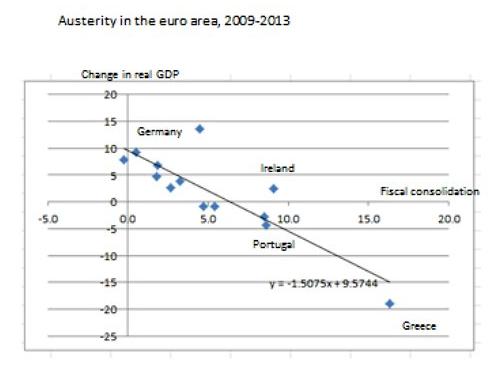
Lagarde gets it, which should give pause to those who blame this crisis on "neoliberalism." If there were such a thing as a neoliberal consensus, the IMF would have to be part of it. But the IMF has gone off in a different direction under the leadership of Lagarde. The WEO contained this graph, which has now been widely reproduced in the blogosphere:

 Paul Krugman explains:

I and others have been arguing for a while that the experience of austerity in the eurozone clearly suggests pretty big Keynesian effects. Here, for example, is what a scatterplot of fiscal consolidation (from the IMF Fiscal Monitor) and growth (including an estimate for next year, from the World Economic Outlook) looks like.
But, you might object, maybe the causation runs the other way; maybe countries in trouble are forced into fiscal consolidation, so it’s not the austerity what did it. But the IMF has an answer to that: it looks at forecast errors versus austerity. Part of the reason for doing this is to figure out why things are going so much worse than expected; but there’s also the fact that the forecasts already included the known problems of the economies in question, so that you’re more or less getting an estimate of the impact of austerity over and above the known problems (and the initially assumed effect of austerity, which was supposed to be small).
Here, "IMF" really means IMF chief economist Olivier Blanchard and economist Daniel Leigh, the authors of "Box 1.1" in the WEO (which can be downloaded here). They argue that the "multiplier" in the world's deleveraging economies is much larger than previously thought, indeed greater than one. Hence fiscal expansion adds more than €1 to GDP for every additional euro of government spending and subtracts more than €1 for every euro slashed by zealous budget cutters. This could make the goal of returning to equilibrium an infinite regress: for every step governments think they are taking toward it, the goal actually recedes by a greater distance. That is why Christine Lagarde is warning of the dangers of a downward spiral into depression. The risk is not negligible, but political systems throughout the developed world seem absolutely incapable of recognizing it. Instead, we slouch toward serfdom.

Sarko le Barbu

Ex-Pres. Sarkozy has grown a beard, as you may have heard. No, he hasn't converted to Islam. Roselyne Bachelot thinks that he will keep the beard as long as he is content to remain out of politics, but the minute he ends his "retirement," the beard will come off.

In any case, he has been talking with reporters about his successors at both the Élysée and the UMP. About Hollande, apparently, he speaks only in mimed gestures: rolled eyes, shrugged shoulders, etc. "Il sait que ses propos sont immédiatement répercutés et qu'un manque d'élégance pourrait lui coûter cher dans l'opinion.:" But it seems that concern about lack of elegance doesn't hold him back when discussing François Fillon: he "has no balls," Sarko says of his former "collaborator." He's just a bourgeois from the Sarthe and will never win the presidency because he doesn't have what it takes to talk to "le peuple."

Take it for what it's worth, folks. Is this a covert endorsement of Copé? It's odd that Sarkozy has no harsh words for JFC, since there was no love lost between the two during his presidency. Maybe he views Copé as a stalking horse for ... himself. If and when he decides to make a comeback, a UMP droitisée by Copé would be a more suitable vehicle than a UMP bourgeoisifiée by Fillon, and Copé, who is running as Sarko bis, would be easier to dislodge than Fillon, however emasculated.

Wednesday, October 10, 2012

Open Education video winners

Creative Commons together with the U.S. Department of Education, and the Open Society Foundation had a competition to create short videos about open education, and these are worth a look (I liked the 3rd prize winner best). My only quibble would be that some of them seem to equate open education with Open Educational Resources (whereas I think there is more to education than providing resources!) http://whyopenedmatters.org/videos/
Photo by Sheila Webber:leaf on a chair, Turku, 2008

Paris Talk

I will be speaking Paris on Oct. 26, 12:30-2 PM, at CEVIPOF. The subject is a comparison of the US and French presidential elections of 2012. Registration is required at the CEVIPOF Web site.

Le Pen Minister?

Did Nicolas Sarkozy consider offering Marine Le Pen the ministry of the interior on the eve of the final presidential debate? According to Bernard Girard, this is the message of a forthcoming book--and the proposal came from Camille Pascal, a centrist, not from one of Sarkozy more extremist advisors such as Patrick Buisson. Remarkable if true. Ã suivre.

Tuesday, October 9, 2012

Imaginaires, représentations, pratiques formelles et non formelles de la recherche d'information sur Internet: PhD thesis

A French-language thesis on schoolchildren's concept of internet searching has just been put online.
Cordier, A. (2011) Imaginaires, représentations, pratiques formelles et non formelles de la recherche d'information sur Internet : Le cas d'élèves de 6ème et de professeurs documentalistes. UNIVERSITÉ CHARLES DE GAULLE – LILLE III. http://tel.archives-ouvertes.fr/tel-00737637
I did not really spend enough time with it (considering my moderate French language skills) to give a good account of what it is about, but I think it is an investigation into 11-12 year old French schoolchildren's experiences of searching the internet, contrasting this experience with what the school librarians have as their goal for information literacy teaching. The latter are urged to pay more attention to the pupil's practice with information and technology.
This is the French abstract "L'objectif de ce travail est d'apporter une meilleure connaissance des imaginaires, représentations et pratiques non formelles développées par les élèves de 6ème sur la recherche d'information sur Internet, et d'effectuer un parallèle et une confrontation avec les pratiques de formation mises en oeuvre par les professeurs documentalistes. Pour ce faire, une étude qualitative, combinant entretiens semi-directifs et observation distanciée, a été menée au sein de trois établissements scolaires français. L'adoption d‟une éco-posture pour analyser la recherche d‟information sur Internet permet de considérer les pratiques de recherche et de formation de manière située, en tenant compte des contraintes opérées par les espaces d'action identifiés. Le sentiment d'expertise personnellement ressenti en matière de recherche sur Internet joue pour les deux types d'acteurs un rôle fondamental à la fois dans l'appropriation de l'outil et dans l'appréhension des séances de formation. L'étude révèle un écart important entre les pratiques de recherche ordinaires des élèves et les pratiques prescrites par les professionnels."
Photo by Sheila Webber: yet more anemones, October 2012

TSCG Adopted

The TSCG has been approved by a vote of 477 to 70, with 282 deputies of the Left voting in favor. In other words, the treaty would not have passed without the support of the Right. Not a brilliant victory for Hollande, but a victory, since he has now committed himself to getting along with Germany. For better or worse, he now owns what used to be called "Merkozy."