Showing posts with label sociology. Show all posts

Saturday, September 8, 2012

Belgium, Here I Come

Hey, I've got nothing against Belgium. Moules-frites, le Manneken pis, insipid beer, language brawls, or proof that life without government is not impossible. But if I were worth €41 billion, I'm not sure I'd want to live there. So has Bernard Arnault been driven into making himself into a Belgian joke by Hollande's promise to tax gazillionaires at a marginal rate of 75%? He denies it. He will keep his French nationality, he says, and remain a "fiscal resident" of France. For Bernard Girard, this is a good thing, indeed, such a good thing that he thinks it ought to be built into EU law. I agree, although I also agree that it might be a tricky law to write.

In general, I think the threat of fiscal self-deportation in response to Hollande's tax policy is overblown, but it gives journalists something to write about. That said, I don't think this symbolic tax is a good idea either. A more comprehensive overhaul of the tax system is what is needed, and this particular approach exposes a large flank to mindless criticism and mock alarm. There are already rumors that the tax is going to be diluted anyway by making it apply to individual rather than household incomes, which opens up a lot of space for creative accounting.

As for Arnault, I've always thought it symbolic of a certain French economic decadence that the country's richest man is the head of LVMH, which stands for Louis Vuitton Moët Hennessy. If you wanted to spell "lap of luxury," you couldn't do better than LVMH (full disclosure: although I don't carry a $4,000 handbag or wear a $750 scarf, I've been known to quaff a glass of VSOP from time to time). Where are the whiz kids writing software or designing cell phones? To be sure, there's always Xavier Niel, who worked his way up from teleporn to telecomms. But there's something depressing about the fact that the biggest moneyman in France is in overpriced luggage. It projects a rather backward image of what is in fact quite a dynamic and diversified economy.

Friday, June 8, 2012

The Right and the Poor

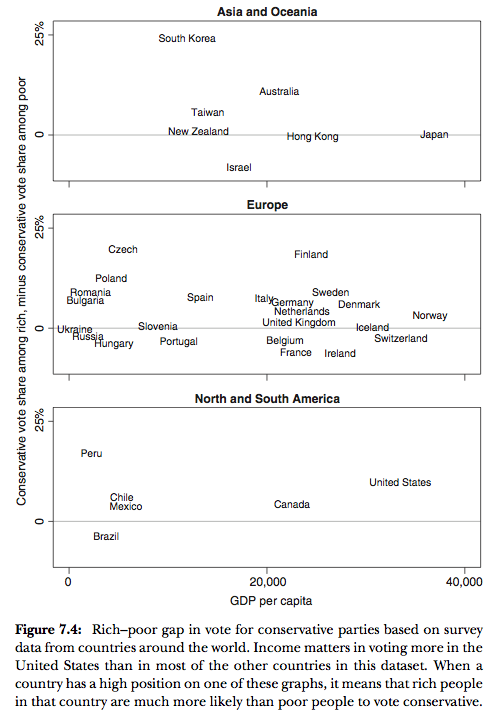
Andrew Gelman sets out to debunk a myth about the US electorate but in the process demonstrates that France is an anomaly. The myth is that blue-collar workers vote for the right in the US, and Gelman claims that this is false. Of course his evidence compares voters in the upper third of the income distribution with those in the lower third, which is not necessarily identical with blue-collar. But what interests me is not whether Gelman is right or wrong but rather the place of France in the middle graph below:


As you can see, France is an outlier, a country with high GDP per capita in which the poorest third of the population is more likely to vote for the Right than for the Left. I wish I knew the source of the data on which these graphs are based.

Monday, May 28, 2012

"Les classes populaires ont changé"

Serge Guérin and Christophe Guilluy argue that social differentiation in France has assumed a new "spatial" configuration, with a sharp division between "cosmopolitan" major cities and smaller towns, exurban areas, rural areas, etc. They believe that this requires a specific response from the state in the form of a reconfiguration of social services. That may be, but I think the larger issue is to try to figure out why the costs of globalization and Europeanization are so unevenly distributed and then to remedy this economic "mal-santé." If that is done, addressing the social "mal-santé" they describe would be both easier and less costly.

Saturday, May 19, 2012

Noiriel Analyzes the FN Vote

Historian Gérard Noiriel analyzes the FN vote. Key point:
A partir des années 1980, la bureaucratisation de la société et la crise de la grande industrie ont liquidé les mouvements de masse entraînant une perte d’autonomie du politique au profit des médias. La « démocratie de partis » a laissé la place à la « démocratie d’opinion ». Le retour de l’extrême droite sur le devant de la scène est à mes yeux une conséquence directe de ces mutations. Le triomphe de la politique-spectacle a créé en effet des opportunités dont s’est saisi Jean-Marie Le Pen, en développant la stratégie des « petites phrases » conçues comme des « bombes médiatiques » qui prennent leur place dans l’actualité au côté des crimes, des catastrophes, des procès etc.
Les journalistes, pris dans les rouages de cette machine médiatique, sont contraints d’accorder de l’importance à ces poseurs de « bombes », contribuant ainsi à l’héroïsation des leaders d’extrême droite. Puisque ces derniers sont devenus des personnages centraux du récit médiatico-politique, les électeurs se sentent autorisés à voter pour le Front National. La réputation sulfureuse de ce parti séduit tout particulièrement ceux qui n’ont plus rien à perdre et qui cherchent à exprimer de la façon la plus radicale possible leur refus d’une société qui ne leur fait pas de place.
This argument strikes me as superficially appealing but empirically unfounded. Is it really true that that the FN "particularly attracts those who have nothing more to lose?" There is a good deal of evidence suggesting that the answer is no. The FN has found support in many segments of society, including retirees and small businessmen who definitely have something to lose. Its working-class support has been increasing, and some of that may come from the unemployed, but some of it also comes from the employed, who have their jobs to lose and fear losing them to immigrants willing to work for lower wages.

What Noiriel wants to call attention to, I think, is the fact that most of the public discussion of FN voters is conducted by "the political-media complex," a fancy term for people like himself and me, who speak of FN supporters as the Other and have no direct contact with the milieux in which a vote for the FN is a live option. We impute attitudes and emotions we do not really fathom: hence the "suffering" narrative, which Noiriel rejects as confabulation. That may be true, but in what respect is "the nothing more to lose" narrative an improvement? Isn't it just another name for the same thing?

Where I think Noiriel is right is in his perception of the way in which Lepenist barbs and provocations, echoed by the media, are used to construct an anti-systemic image. For voters whose judgment is that "the system" has failed them, the response is to seek the candidate whose provocations seem most disruptive of what they see as the routinized and ritualized exchanges that constitute the mainstream discourse. In the ensuing surenchère of acerbic attitude, anti-system candidates compete with each other in a closed rhetorical universe that hives itself off as a separate realm of what Noiriel calls the "democracy of opinion," in which one opinion is deemed as good as another simply because it is voiced and without need for the kind of justification once provided by ideology in the "democracy of parties." Hence the intense media interest in the Le Pen-Mélenchon face-off in Hénin-Beaumont. Nothing of consequence will be decided here, but the battle of provocateurs will surely défrayer la chronique.

Thursday, May 17, 2012

An Interesting Observation about the Government

Bernard Girard makes an interesting observation about the government that I haven't heard anywhere else:

Il est intéressant de comparer ce gouvernement et le premier de Pierre Mauroy : on y trouve plus de femmes, plus de ministres issus de la diversité mais aussi plus d'agégrés et, surtout, d'héritiers de la bourgeoisie intellectuelle, de cette bourgeoisie du savoir qui a accumulé un capital universitaire, des postes dans l'université et pour certains au moins une réputation internationale : les pères de Moscovici et Touraine sont des intellectuels de grand renom, Peillon (qui a été directeur de recherche au CNRS) est le neveu d'un professeur au Collège de France… Mauroy recrutait, lui, plutôt des infirmiers et des profs de l'enseignement technique.

Saturday, May 12, 2012

Monday, May 7, 2012

Sociology of the Vote

Hollande won in all age groups except 60+ and all socioprofessional groups except "commerçants, artisans, chefs d'entreprise," a heterogeneous grouping if ever there was one, and "retirees," which presumably overlaps the 60+ group. And he did equally well with men and women.

Tuesday, April 24, 2012

Sociological Data on the Vote

From IPSOS, here:


Comme d'habitude, les plus forts taux d'abstention sont relevés
  • chez les plus : 27% chez les 18-24 ans, 26% chez les 25-34 ans, 28% chez les 35-44 ans, contre 17% chez les 45-59 ans et 14% chez les "60 ans et plus".
  • dans les catégories populaires : 29% chez les ouvriers, 32% chez les "sans diplôme", 34% dans les foyers dont le niveau de revenu mensuel est inférieur à 1200€
François Hollande
L'électorat de François Hollande se caractérise par son homogénéité. Il est en tête dans la plupart des catégories socio-démographiques testées, à l'exception des soutiens traditionnels de la droite, + de 60 ans, retraités, indépendants. Il obtient 30% des voix chez les salariés, 28% chez les personnes à leur compte ; 39% chez les sans diplômes, 31% chez les plus diplômés ("au moins bac +3") ; 30% dans la tranche de revenu la plus basse (revenu du foyer inférieur à 1200€), 31% dans la tranche la plus haute (revenu du foyer supérieur à 3000€) . Deux motivations principales chez ses électeurs : "l'incarnation du changement" (65%) et la stratégie de vote utile pour qu'il obtienne le meilleur score possible au premier tour (80%).  François Hollande a convaincu 71% des électeurs de Ségolène Royal et 27% des électeurs de François Bayrou en 2007.
Nicolas Sarkozy
S'il reste en tête au sein des soutiens traditionnels de la droite, on observe tout de même un recul par rapport à 2007 : -8 points chez les retraités (33%), -2 points chez les artisans, commerçants, chefs d'entreprise (42%). Son électorat s'est prononcé d'abord en fonction de la stature du Président sortant (86% de citations). Mais Nicolas Sarkoy ne retrouve que 73% de ses électeurs du premier tour 2007, 13% ont préféré voté cette fois ci pour Marine Le Pen.
Marine Le Pen
Marine Le Pen est troisième chez les 18-24 ans (18%), assez loin derrière François Hollande (29%) et Nicolas Sarkozy (28%). Elle obtient en revanche le meilleur score chez les ouvriers (29%), devant François Hollande (27%). Sa candidature a attiré 13% de l'électorat 1er tour de Nicolas Sarkozy en 2007, et 9% de celui de François Bayrou. Les deux tiers de ses électeurs l'ont d'abord choisie parce "qu'elle répondait à leurs préoccupations" (67%). Elle est ainsi avec Eva Joly la seule candidate pour laquelle cette motivation est citée en premier.
Jean-Luc Mélenchon
Jean-Luc Mélenchon réalise ses meilleurs scores auprès des professions intermédiaires (14%), des salariés du public (14%), des chômeurs (19%) et des non diplômés (14%). Il récupère 15% des électeurs 1er tour de Ségolène Royal en 2007, et 8% des électeurs de François Bayrou. Au total, 23% des sympathisants de gauche ont voté pour lui, moins pour qu'il soit élu que par souhait que "ses idées pèsent dans le débat" (59% de citations).
François Bayrou
François Bayrou ne rassemble que 39% des électeurs qui l'avaient choisi en 2007. Il fait un peu mieux que son score moyen auprès des plus diplômés (12%), des personnes "à leur compte" (13%)  et des "cadres et professions libérales" (12%).